
 ENG
ENG
 POL
POL


Peer Review Process
This page explains the editorial and peer-review workflow used by Państwo i Społeczeństwo / State and Society, from manuscript submission to publication.
The journal applies a multi-stage editorial assessment, plagiarism screening, and double-blind peer review. Authors asked to revise a manuscript must follow the separate revision-file requirements described below.
Revision instructions: Preparing and Submitting Revised Files
Article Submission and Peer Review Procedure ↑
All manuscripts submitted to the journal Państwo i Społeczeństwo / State and Society, including those submitted to any special or thematic issues, undergo a rigorous, multi-stage editorial and peer-review procedure designed to ensure the highest scholarly quality and compliance with international ethical standards. The detailed course of the process is presented below.
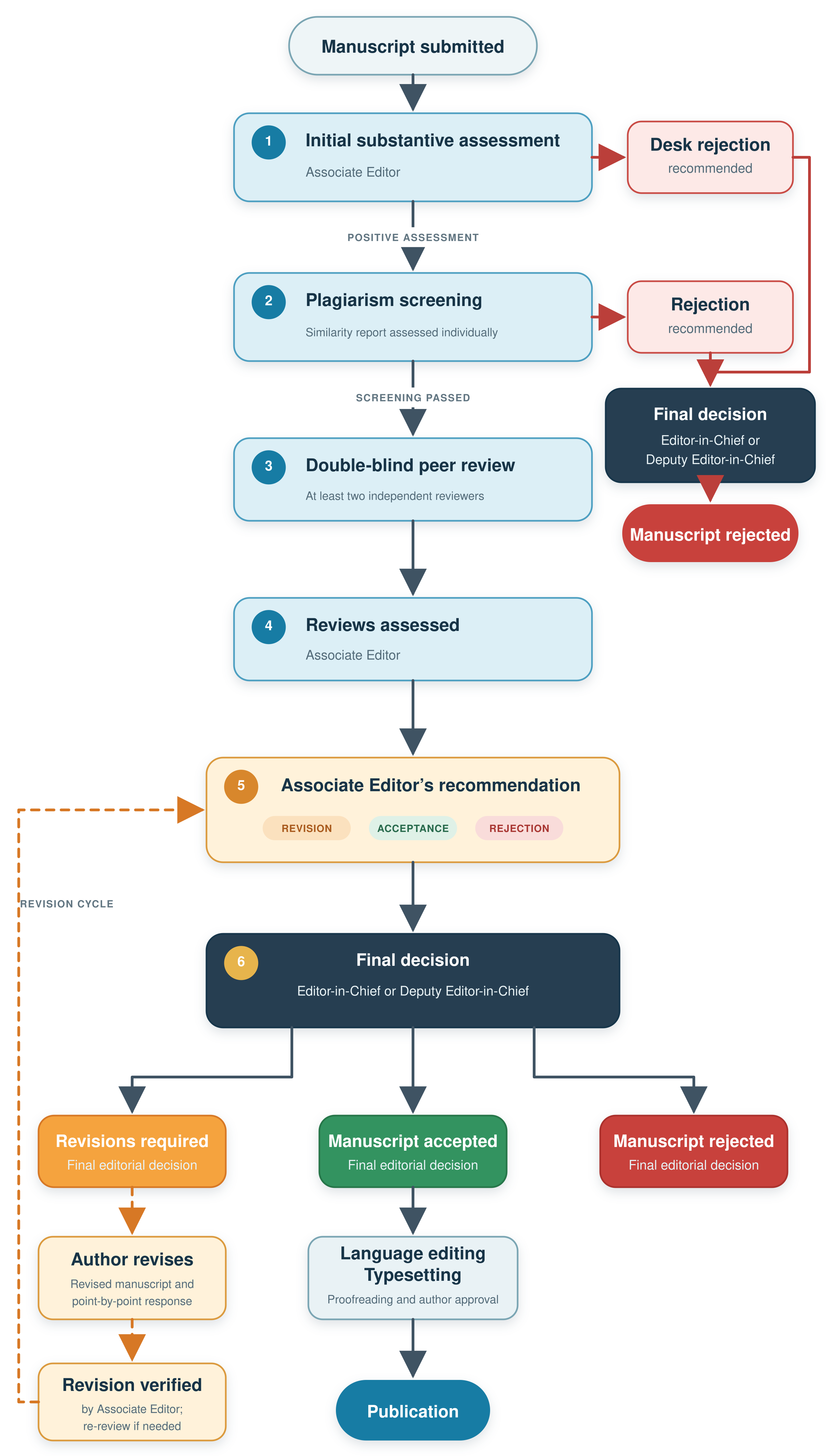
Manuscript submission ↑
Authors submit manuscripts through the Open Journal Systems platform. Guidelines concerning manuscript preparation and the required documents are available here.
Initial editorial assessment (Desk Review) ↑
The Managing Editor conducts an initial technical and formal assessment of the submission, including:
- compliance with the thematic scope of the journal,
- fulfilment of the formal requirements set out in the Guide for Authors.
If these requirements are not met, the manuscript is returned to the Author with a request for correction and/or completion.
A manuscript that meets the formal requirements is forwarded to the Section Editor for substantive assessment.
If the manuscript does not fall within the thematic scope of the journal or does not meet the required scholarly quality standards, including originality, scientific potential, and appropriate use of the relevant literature, the Section Editor recommends its rejection. The Editor-in-Chief makes the final decision to reject the manuscript at this stage (Desk Reject). The Editorial Office is not obliged to provide detailed reasons for rejecting a manuscript at the initial stage.
Plagiarism screening ↑
Manuscripts that receive a positive substantive assessment are submitted for plagiarism screening.
A high similarity index or lack of references to sources results in the rejection of the manuscript. The journal does not apply fixed percentage thresholds for determining plagiarism. Each similarity report is analysed and assessed individually by the Editorial Office. Every borrowing from another publication must be accompanied by an appropriate reference.
Manuscripts that successfully pass the plagiarism screening are forwarded for peer review.
Peer review — double-blind peer review ↑
Manuscripts qualified by the Section Editor for the next stage are sent for review in accordance with the principle of double anonymity, namely double-blind peer review:
- reviewers do not know the identity of the Author(s),
- Authors do not know the identity of the reviewers.
The Section Editor appoints at least two independent reviewers affiliated with institutions other than those of the manuscript’s Author(s). Reviewers are selected on the basis of their expertise in the relevant field and the absence of any conflict of interest.
Preparation of reviews ↑
Reviewers assess manuscripts using a standard review form, taking into account, among other things:
- the quality of argumentation and logical structure,
- coherence and linguistic precision,
- the currency and relevance of the selected literature,
- the originality of the approach to the topic.
The review includes one of the following recommendations:
- acceptance without revisions,
- acceptance subject to revisions,
- rejection of the manuscript.
Each recommendation must be justified in detail. The deadline for preparing a review in the first round is 14 days; in the second and subsequent rounds, where applicable, the deadline is 7 days.
Editorial Recommendation and Final Decision ↑
On the basis of the reviews, the Section Editor formulates a recommendation regarding the publication of the manuscript. However, the Section Editor acts strictly in an advisory capacity. The ultimate and decisive authority regarding the acceptance or rejection of a manuscript rests solely with the Editor-in-Chief (EiC) and/or the Deputy Editor-in-Chief.
The process proceeds as follows:
- Acceptance without reservations — both reviews are positive and contain no substantive comments. The Section Editor recommends acceptance.
- Revisions required — Authors are required to revise the manuscript in accordance with the reviewers’ comments or provide a justified response where a comment is not implemented. The revised submission must be prepared according to the requirements set out in the section “Preparing and Submitting Revised Files”. The Section Editor verifies whether the manuscript has been revised in accordance with the reviewers’ recommendations. At the reviewer’s request, the manuscript may be sent for re-review. If the re-review is negative, rejection may be recommended.
- One negative review — the Section Editor may recommend rejecting the manuscript or sending it to a third reviewer, whose opinion will guide the final recommendation.
- Two negative reviews — the manuscript is unequivocally recommended for rejection. No procedure for revising the manuscript is provided after two negative reviews.
Final Decision: After reviewing the Section Editor's recommendation and the peer-review reports, the Editor-in-Chief and/or Deputy Editor-in-Chief make the final decision. This decision is absolute, final, and not subject to appeal regarding the scientific merit and academic evaluation of the manuscript.
Preparing and Submitting Revised Files ↑
If the editorial decision requires revisions, Authors must prepare and upload a revised submission within the deadline indicated by the Editorial Office. The purpose of the revision stage is to show clearly how the manuscript has been changed in response to the reviewers’ and editors’ comments.
At the revision stage, Authors must submit the following anonymised files:
- a revised manuscript with all changes clearly indicated — changes should be marked either by using Track Changes or by highlighting the modified text in colour;
- a detailed point-by-point response to the reviewers’ and editors’ comments — the response must address each comment separately and in a structured manner;
- a clean revised version of the manuscript, if requested by the Editorial Office.
The response file should be organised clearly, for example:
Reviewer 1, Comment 1: [quote or summarise the reviewer’s comment]
Response: [explain how the comment was addressed]
Changes in the manuscript: [indicate the exact place in the manuscript where the revision was introduced]
Authors should respond to every comment raised by each reviewer and, where applicable, by the Editorial Office. The response must clearly indicate what was changed, where the change was introduced, and how the revision addresses the comment. If the Authors decide not to implement a specific comment, they must provide a clear, scholarly, and reasoned justification.
All files submitted at the revision stage must remain fully anonymised. In particular, the revised manuscript, the response to reviewers, file names, document metadata, acknowledgements, funding statements, self-identifying references, supplementary materials, and any other uploaded files must not disclose the names, affiliations, institutional details, e-mail addresses, ORCID identifiers, project identifiers, acknowledgements, or any other information that could reveal the identity of the Author(s).
Submission of non-anonymised files or files that do not meet the above requirements constitutes a breach of the double-blind peer-review procedure. The Editorial Office reserves the right to return such a submission for correction without further processing or, in justified cases, to reject the manuscript on formal grounds.
Final qualification for publication ↑
After the revised manuscript has been verified by the Section Editor and formally accepted by the Editor-in-Chief, it is forwarded for language editing.
Language editing and author approval ↑
After completion of the peer-review procedure, manuscripts are forwarded for language editing. In the case of manuscripts written in English, the text is additionally checked by a translator or native speaker. Authors then receive the edited manuscript for approval of the introduced changes. Failure to respond within the prescribed deadline is treated as acceptance of the text.
The Editorial Office reserves the right to propose revisions based on its own assessment and/or the reviewers’ opinions, and may make publication of the manuscript conditional upon their implementation.
If any doubts concerning the manuscript arise at the stage of editorial work carried out by the Publishing House, including editing or author approval, they are resolved definitively by the Editor-in-Chief.
Typesetting and post-typesetting proofreading ↑
After the introduced changes have been approved, the manuscript is sent for typesetting and then for post-typesetting proofreading carried out by the Publishing House. The article in PDF format is then sent to the Author for final author proofreading. The deadline for this stage is 48 hours. Failure to respond within the prescribed deadline is treated as acceptance of the text.
Publication ↑
Articles are published on the journal’s website and indexed in relevant scholarly databases. All articles are made available in Open Access under the Creative Commons Attribution–NonCommercial–NoDerivatives 4.0 International licence (CC BY-NC-ND 4.0).
Publication charges ↑
The journal does not charge any fees for manuscript submission or publication. The costs of preparing the article for publication are fully covered by the Publisher.
Vol. 26 (2026)
Published: 2026-01-01
eISSN: 2451-0858
 10.31749/2451-0858-SaS
