 ENG
ENG


About
About the Journal
European Polygraph is an international scholarly journal devoted to the detection of deception, in particular to polygraph examinations and their scientific foundations in psychology, psychophysiology, forensic science and other forensic disciplines. The journal also addresses the ethical aspects of such examinations and their legal regulation.
The journal is also devoted to the history and practice of deception detection, its techniques and methodology, as well as its applications in various areas of security protection, including criminal investigation, court proceedings, and the work of police and special services.
European Polygraph serves as an international forum for the exchange of scientific knowledge, research findings, practical experience, and theoretical reflection concerning deception detection. A particularly important place in the journal’s profile is occupied by the psychological dimension of polygraph examinations and other methods of credibility assessment, including the psychological mechanisms of deception, cognitive and emotional processes related to the examinee’s responses, psychophysiological symptoms accompanying deception, and the proper interpretation of psychophysiological reactions.
The aim of the journal is to publish reliable, original, and methodologically sound scholarly works that contribute to the development of knowledge on deception detection, polygraph examinations, and their application in forensic, investigative, security, administrative, and professional contexts. The journal combines scientific and practical perspectives, facilitating the exchange of experience among researchers, forensic experts, psychologists, lawyers, criminologists, security specialists, and polygraph practitioners.
Thematic Scope
The thematic scope of the journal includes in particular:
- the psychological mechanism of deception;
- psychophysiological symptoms accompanying deception;
- legal and ethical frameworks for deception detection;
- the use of polygraph examinations and other forms of instrumental and non-instrumental deception detection in criminal proceedings, security protection, and information verification;
- techniques and methods of polygraph examinations, including their validity, reliability, and utility;
- prospects for deception detection at the neurophysiological level;
- analyses of practice and case studies in the field of deception detection;
- the history of polygraph examinations and other methods of deception detection;
- expert training and professional standards in this field;
- book reviews, literature reviews, and reports from conferences and seminars devoted to the journal’s subject matter.
Types of Publications
European Polygraph publishes original articles, including works based on empirical and experimental research, review articles, case studies, analyses of practice, legal and historical studies concerning deception detection, book reviews, and literature reviews within the thematic scope of the journal.
Editorial and Publishing Policies
Peer Review Process
The journal applies a double-blind peer-review procedure. This means that the identities of the authors are not disclosed to reviewers, and the identities of reviewers are not disclosed to authors. Each scholarly article is normally assessed by independent reviewers with expertise relevant to the subject matter of the submitted manuscript.
The editorial process includes initial screening for relevance to the journal’s scope, formal assessment, scholarly peer review, editorial decision, possible author revisions, language and technical editing, and final preparation for publication.
Editorial decisions are based exclusively on scholarly merit, originality, methodological quality, relevance to the journal’s scope, and compliance with publication ethics.
Open Access Policy
European Polygraph is an open access journal. Articles published in the journal are made available online to readers without access charges. The aim of the open access policy is to increase the visibility, accessibility, and impact of published research within the international scholarly and professional community.
Article Processing Charges
The journal does not charge authors any fees for manuscript submission, editorial assessment, peer review, publication, or online access to published articles. There are no submission charges, article processing charges, publication charges, page charges, or colour charges.
Copyright and Open Access License
Articles published in European Polygraph are made available under the journal’s open access policy. Unless otherwise stated, articles are published under the following Creative Commons license:
This means that users may copy and distribute the published article, provided that the original author and source are properly credited, the article is not used for commercial purposes, and the article is not modified, transformed, or adapted.
Publication Ethics
European Polygraph is committed to maintaining high standards of publication ethics and scholarly integrity. Authors, editors, reviewers, and the publisher are expected to act in accordance with the principles of honesty, transparency, confidentiality, accountability, and respect for intellectual property.
The journal does not accept plagiarism, self-plagiarism, data fabrication, data falsification, manipulation of research material, ghostwriting, guest authorship, honorary authorship, redundant publication, or simultaneous submission of the same manuscript to another journal or publisher.
Authors are required to disclose conflicts of interest, sources of funding, the contribution of individual authors, and permissions for the use of copyrighted material where such material is included in the manuscript.
If a breach of publication ethics is identified, the journal may take appropriate action, including rejection of the manuscript, publication of a correction, expression of concern, or retraction of the article.
Funding and Journal Development
European Polygraph received funding from the Ministry of Science and Higher Education of the Republic of Poland under the programme Rozwój czasopism naukowych, project no. RCN/SN/0150/2021/1.
The amount of co-financing is 47,000 PLN, with a total project cost of 124,000 PLN.
The project supports the development of editorial practices, improvement of the journal’s online visibility, enhancement of citation metrics, and strengthening of its prospects for inclusion in leading international bibliographic and bibliometric databases.

Scoring, Indexing and Availability
European Polygraph is listed as a scored scientific journal. The journal is available internationally and is visible in various scientific databases, catalogues, and repositories. The journal has ISSN 1898-5238 and eISSN 2380-0550.
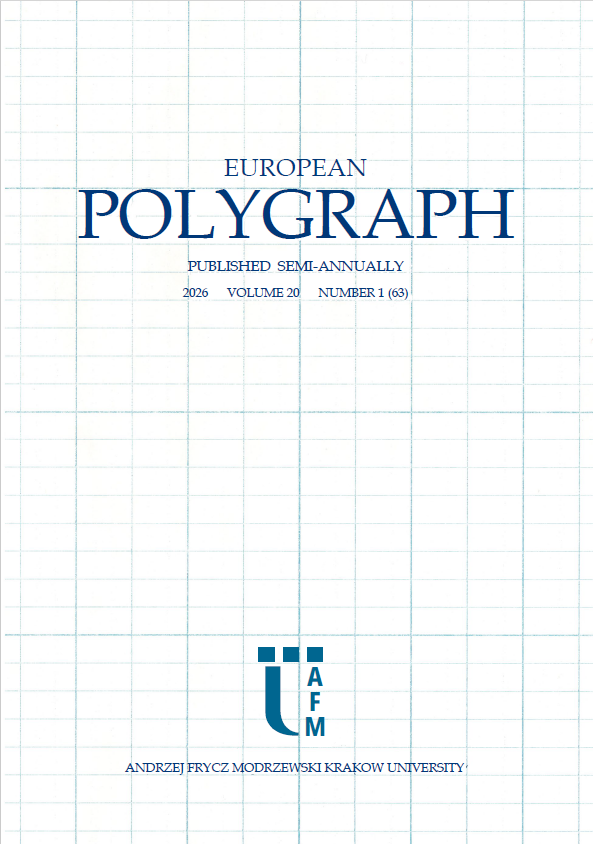
Vol. 20 No. 1 (2026)
Published: 30-06-2026
eISSN: 2380-0550
