
 English
 Język polski


Submissions
As part of the submission process, authors are required to check off their submission's compliance with all of the following items, and submissions may be returned to authors that do not adhere to these guidelines.
- The submission has not been previously published, nor is it before another journal for consideration (or an explanation has been provided in Comments to the Editor).
- The submission file is in OpenOffice, Microsoft Word, or RTF document file format.
- Where available, URLs for the references have been provided.
- The text is single-spaced; uses a 12-point font; employs italics, rather than underlining (except with URL addresses); and all illustrations, figures, and tables are placed within the text at the appropriate points, rather than at the end.
- The text adheres to the stylistic and bibliographic requirements outlined in the Author Guidelines.
- The article is academic in nature and presents new research findings.
- The topic aligns with the aims and scope of the journal.
- The title accurately reflects the content of the article.
- The article is not a repetition or compilation of previous works, including those by the same author (text recycling/self-plagiarism).
-
The article has not been published previously.
- The article has not been submitted previously or simultaneously to other publishers.
- The topic aligns with the aims and scope of the journal.
- The language of the manuscript is correct, clear, and precise.
- The cited literature represents the current state of knowledge in the field.
- The final conclusions are logical and original.
- The file has been carefully prepared in accordance with the Author Guidelines.
- The article is properly structured and divided into sections.
-
Citations and the bibliography have been prepared according to the APA 7th edition rules
- All graphic elements include alternative text (alt-text).
Author Guidelines
Manuscript preparation
Medicine and Public Health follows the International Committee of Medical Journal Editors recommendations for manuscripts. Full text available at: http://www.icmje.org/icmje-recommendations.pdf.
Manuscripts should be written in clear, grammatical English (American spelling).
Due to the double-blind review, the authors should avoid in the text information which may compromise their anonymity.
Title page information:
- title should be concise, relevant and free of abbreviations,
- author names and affiliations
- contact details to correspodning author
- Word count (excluding Abstract, References, Tables and Figure Legends)
- Number of Figures and Tables to be found in paper
The text of the original works should be divided into sections:
- Introduction,
- Material and Methods,
- Results,
- Discussion,
- Conclusions.
For original articles, we strongly encouraging to use the Microsoft Word template to prepare their manuscript. Submitting manuscript in one of the following formats: DOC, DOCX, RTF, ODT, is also allowed.
Review article should include:
- Introduction,
- Titles of sections,
- Summary of the discussed issues,
- Conclusions.
We recommend following PRISMA Guidelines on preparing systematic reviews and meta-analyses. A PRISMA Flow Diagram serving as graphical representation of the flow of citations reviewed in the course of a Systematic Review may be created with the use of a generator available at: http://prisma.thetacollaborative.ca.
Abstract should contain:
- Background,
- Methods,
- Results,
- Conclusions.
Keywords are mandatory for original articles and reviews; maximum 5 items should be included in the text.
All Figures should be numbered in a single sequence in the order which are mentioned in the text.
Each Figure should be submitted as a separate file. They should be high resolution and in one of the following formats: JPG, GIF, TIF, PNG.
Figure Legends must be added as a complete list after the main body of the manuscript. Do not include title and legend in submitted Figures files.
All Tables should be numbered in the order of their citation in the text. Each Table should have title and legend. Footnotes are allowed.
Tables might be submitted on separate pages, with double spacing in the same file as submitted the manuscript or as a separate files (DOC, DOCX, RTF, ODT).
Formatting requirements:
- the text of the article should be typed with 12-point Times New Roman font with 2.0 line spacing; all pages must be numbered and must contain line numbers,
- foreign words and phrases should be written in italics,
- do not use bold or emphasis (or explain their use),
- all abbreviations must be explained at first mention in the text,
- footnotes are not allowed, except Tables,
- units must be expressed following the international system of units (SI),
- equations should be editable by the editorial office and not appear in a picture format.
Maximum work volume and other requirements are presented in the table below.
| Article types: | Structured abstract | Word count* | Tables | Figures | References | Structured |
|---|---|---|---|---|---|---|
| Original | yes/250 words | 5000 | 8 | 4 | 40 | yes |
| Original (randomized clinical trial) | yes/300 words | 5500 | 8 | 4 | 40 | yes |
| Reviews & meta-analyses | yes/250 words | 6000 | 4 | 3 | 60 | yes |
| Case Report | yes/200 words | 1500 | 2 | 1 | 25 | yes |
| Short Report | yes/200 words | 1200 | 1 | 1 | 25 | yes |
| Drug Report | yes/200 words | 1000 | 2 | 1 | 25 | yes |
| Comment | no | 750 | 1 | 1 | 10 | no |
| Correspondence | no | 500 | 0 | 0 | 10 | no |
| Image of the issue (clinical picture) + comment** | no | 200 | 0 | 1 | 5 | no |
| Editorial | no | 600 | 0 | 1 | 15 | no |
* Word count – excluding Abstract, References, Tables and Figure Legends.
** Each image can have a 200-word comment.
In the text, References need to be numbered in order to appear in the manuscript by Arabic numerals in square brackets. The modified Vancouver style of citation should be used. For authors' names, the general rule is up to 5 names before "et al.".
DOI numbers are not mandatory but highly encouraged.
Examples:
- Barczyński M, Gołkowski F, Nawrot I. The current status of intraoperative iPTH assay in surgery for primary hyperparathyroidism. Gland Surg. 2015 Feb;4:36-43, doi: 10.3978/j.issn.2227-684X.2015.01.01.
- Hymczak H, Gołąb A, Mendrala K, Plicner D, Darocha T, et al. Core Temperature Measurement-Principles of Correct Measurement, Problems, and Complications. Int J Environ Res Public Health. 2021;18:10606, doi: 10.3390/ijerph182010606.
Copyright Notice
Authors of the articles published in Bezpieczeństwo. Teoria i Praktyka/ Security. Theory and Practice retain copyright to their works without restriction. Based on a signed declaration submitted with the article, the Authors agrees to granting the Publisher free and unlimited access to the work under the terms of the Creative Commons CC BY-NC-ND 4.0 International license (Attribution – Non Commercial – No Derivatives) in order to place the work in the Publisher's repository, on the journal's website and make it available in the Internet in other databases of scientific articles in Open Access.
Privacy Statement
The names and email addresses entered in this journal site will be used exclusively for the stated purposes of this journal and will not be made available for any other purpose or to any other party.
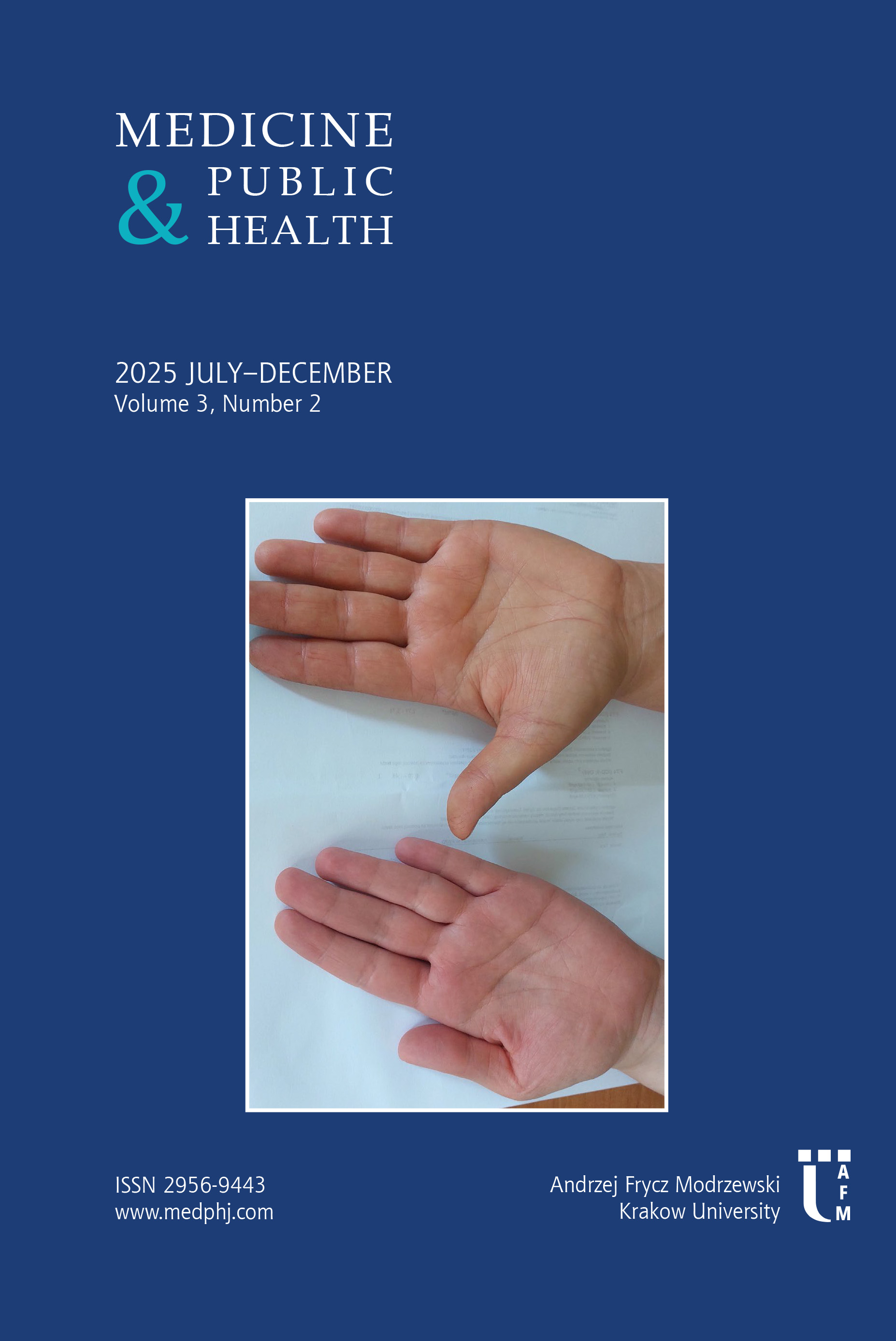
Vol. 3 No. 2 (2025)
Published: 2026-05-10
eISSN: 2956-9443
